Oral Probiotics for Bad Breath and Gum Health: A Complete Guide (2026)
You brush twice a day, floss and use mouthwash, yet by mid-afternoon your breath isn't as fresh as you'd like. Bad breath is incredibly common, and in most cases it starts in the mouth itself, with bacteria on the tongue, between the teeth and along the gums. Oral probiotics are a newer approach that's getting a lot of attention: instead of trying to kill all bacteria, they add good bacteria to support a healthier balance. Here's how they work, which strains matter, and how to choose one.
- Most bad breath comes from bacteria in the mouth, especially on the back of the tongue.
- Oral probiotics aim to support a healthier balance of mouth bacteria rather than wiping everything out.
- Strains like L. reuteri, L. paracasei and B. lactis are commonly studied for oral health.
- One option is ProDentim, a chewable oral probiotic with 3.5 billion CFU and a 60-day guarantee.
Products Compared at a Glance
What Really Causes Bad Breath
Bad breath (halitosis) usually comes from volatile sulfur compounds produced by bacteria that break down food particles and proteins in the mouth. The most common sources are:
- The tongue: the rough surface at the back of the tongue traps bacteria and debris.
- Gums: plaque along the gumline and gum problems are a frequent cause.
- Dry mouth: saliva naturally rinses the mouth; less saliva (from medications, mouth breathing or age) means more odor.
- Food and drinks: garlic, onions, coffee and alcohol.
- Smoking.
Dry mouth deserves special attention after 40. According to the National Institute of Dental and Craniofacial Research, dry mouth is often a side effect of medications, including many taken for blood pressure, allergies and depression. It isn't a normal part of aging, and it's worth mentioning to your doctor or dentist if your mouth often feels sticky or dry.
Less commonly, bad breath can be linked to sinus problems, reflux or other health conditions, which is why persistent bad breath deserves a dental check-up. The American Dental Association offers a helpful overview.
How Oral Probiotics Work
Your mouth hosts hundreds of bacterial species. Many are harmless or helpful; others contribute to odor and gum problems. Strong antiseptic mouthwashes reduce bacteria temporarily, but they don't choose between good and bad, and the odor often returns within hours.
Oral probiotics take the opposite approach: they add beneficial bacteria to help crowd out the odor-producing ones and support a healthier balance over time. That's why they come as chewable tablets or lozenges: they need to work in the mouth, not just in the gut. Learn more about the strains in our oral probiotic strains guide.
What the Research Says
Probiotics are an active area of research, and oral probiotics are a newer branch of it. The NCCIH stresses an important point: effects are strain-specific, so findings for one strain don't automatically apply to another, and research for many uses is still preliminary.
For breath and gum health specifically, small clinical studies on strains such as L. reuteri and L. paracasei have reported encouraging short-term results for markers like odor compounds and plaque, but studies are often small and results vary. What the evidence does not show is that probiotics can replace brushing, flossing, tongue cleaning or professional dental care.
That's a reasonable frame for your expectations: an oral probiotic is a supportive daily habit that may help some people maintain a fresher-feeling mouth, not a fix on its own.
Oral Probiotics vs. Mouthwash vs. Tongue Cleaning
| Oral probiotic | Antiseptic mouthwash | Tongue cleaning | |
|---|---|---|---|
| How it works | Adds beneficial bacteria | Reduces bacteria, good and bad | Removes coating where odor bacteria live |
| How fast | Gradual, over weeks | Immediate, short-lived | Immediate, needs to be daily |
| Cost | Ongoing monthly cost | Low | Very low (a scraper or toothbrush) |
| Best used | After brushing, once a day | Occasionally, separated from probiotics | Every morning |
These aren't either-or choices. Many people get the best results by combining daily tongue cleaning with good brushing and flossing, and adding an oral probiotic on top.
How to Choose an Oral Probiotic
- Look for named strains. A label that lists specific strains (such as B. lactis BL-04®) is more transparent than one that just says “probiotic blend.”
- Check the CFU count. Colony-forming units tell you how many live bacteria are in each serving. Billions per serving is typical for quality products.
- Choose a format that works in the mouth. Chewables and lozenges keep the bacteria where breath and gum issues start; swallowed capsules mostly target the gut.
- Prefer sugar-free or low-sugar formulas. Sugar feeds the bacteria you're trying to crowd out.
- Look for a prebiotic, such as inulin, which helps feed beneficial bacteria.
- Check manufacturing and storage instructions, and buy from the seller's site so the product is fresh and covered by the guarantee.
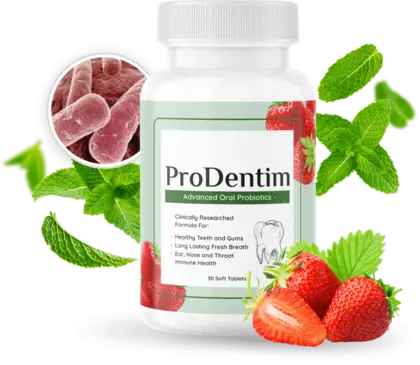
ProDentim, a Chewable Oral Probiotic With 3.5 Billion CFU
ProDentim
3.5 billion CFU from 3 strains, strawberry-mint flavor. 60-day guarantee. From $49 per bottle.
Check Pricing → Read our full reviewProDentim combines three strains, Lactobacillus paracasei, B. lactis BL-04® and Lactobacillus reuteri, for a total of 3.5 billion CFU, with inulin (a prebiotic fiber that feeds good bacteria), malic acid, tricalcium phosphate and peppermint. You slowly chew one tablet every morning, and the strawberry-mint flavor makes it easy to remember.
It's non-GMO, gluten-free and stimulant-free, made in an FDA-registered facility. One bottle costs $69 (plus $9.95 shipping), three cost $59 each and six cost $49 each, with free US shipping and two bonus guides on the larger packages. Every order has a 60-day money-back guarantee.
How to Get the Most Out of an Oral Probiotic
- Take it after brushing in the morning, chewing slowly so the probiotics spread through your mouth.
- Don't rinse with strong mouthwash right afterwards; give the good bacteria time to settle.
- Clean your tongue daily with a scraper or your toothbrush.
- Drink water through the day to avoid dry mouth.
- Be consistent: give it at least 4–8 weeks.
Daily Habits for Fresher Breath
- Brush twice a day for two minutes and floss daily.
- Replace your toothbrush every three months.
- Chew sugar-free gum to stimulate saliva.
- Limit coffee, alcohol and tobacco.
- See your dentist for cleanings every six months.
Foods and Drinks That Help (or Hurt) Your Breath
What you eat and drink affects your breath in two ways: through strong-smelling compounds, and by how it changes saliva and the bacteria in your mouth.
Breath-friendly choices:
- Water, sipped throughout the day, keeps saliva flowing.
- Crunchy fruits and vegetables like apples, carrots and celery stimulate saliva and help clean tooth surfaces.
- Plain yogurt and other unsweetened fermented foods fit well with a probiotic-friendly routine.
- Sugar-free gum with xylitol encourages saliva after meals.
Common culprits: garlic, onions, coffee, alcohol, sugary snacks and drinks, and very low-carb diets, which can produce a distinctive breath odor. You don't need to give these up entirely; just brush, rinse with water or clean your tongue afterward when you can.
A Realistic Timeline
- Days 1–7: focus on the routine: brush, clean your tongue, then chew one tablet slowly. Some people notice mild digestive changes in the first days, which is common with probiotics.
- Weeks 2–4: some people notice their mouth feels fresher for longer, especially in the morning.
- Weeks 4–8: the fairest window to judge results. Ask someone you trust for an honest opinion, since it's hard to judge your own breath.
What It Costs per Month
Each bottle holds 30 chewable tablets, a 30-day supply:
| Package | Per bottle | Approx. per day |
|---|---|---|
| 1 bottle | $69 + $9.95 shipping | about $2.30 (before shipping) |
| 3 bottles | $59 | about $1.97 |
| 6 bottles | $49 | about $1.63 |
For comparison, many people spend a similar amount each month on mints, gum and mouthwash that only mask odor for a short time. Confirm current pricing on the seller's site before ordering.
Gum Health After 40: What to Watch For
Gum health and breath are closely connected. The NIDCR explains that gum disease is common in adults and often painless in its early stages, so it's easy to miss. Signs to watch for include:
- Gums that bleed when you brush or floss.
- Red, swollen or tender gums.
- Gums pulling away from the teeth.
- Bad breath or a bad taste that won't go away.
- Loose teeth or a change in your bite.
Any of these are a reason to see your dentist. Early gum problems are much easier to manage with professional care and good daily habits.
Who Should Talk to a Doctor First
- People with a weakened immune system, for example from chemotherapy, an organ transplant or immune-suppressing medication.
- Anyone who is seriously ill or recovering from major surgery.
- Women who are pregnant or breastfeeding.
For most healthy adults, probiotics are generally well tolerated, but it's always reasonable to show the label to your dentist or pharmacist.
Common Mistakes to Avoid
- Swallowing the tablet quickly. Oral probiotics need time in the mouth; chew slowly and let it dissolve.
- Using strong mouthwash right after. Give the probiotic time to settle first.
- Skipping tongue cleaning, the single most overlooked step for fresher breath.
- Masking the problem with mints. Sugary mints can feed the bacteria behind bad breath.
- Ignoring persistent bad breath. If it doesn't improve with good hygiene, see your dentist.
How We Chose
We summarized the seller's product website, the full ingredient list, strains and CFU count, format, manufacturing details, pricing and refund terms. We favored chewable formats with named strains, a prebiotic, no stimulants and a clear guarantee, and we compared the product's positioning with what dental and public health sources say about bad breath. This comparison reflects our own opinion. Learn how we review.